top of page


LaG - Latent Glitch [ Media Art ]
Unit /

Spatial Forces
Framing Nature is a site-specific interactive light installation located in Zabeel Park, conceived in direct dialogue with the Dubai Frame, positioned at the intersection of art, technology, and ecology.
While the Dubai Frame monumentalizes the city by framing the urban skyline, Framing Nature applies the same architectural operation to ecology, framing living trees as individual subjects within the urban environment.
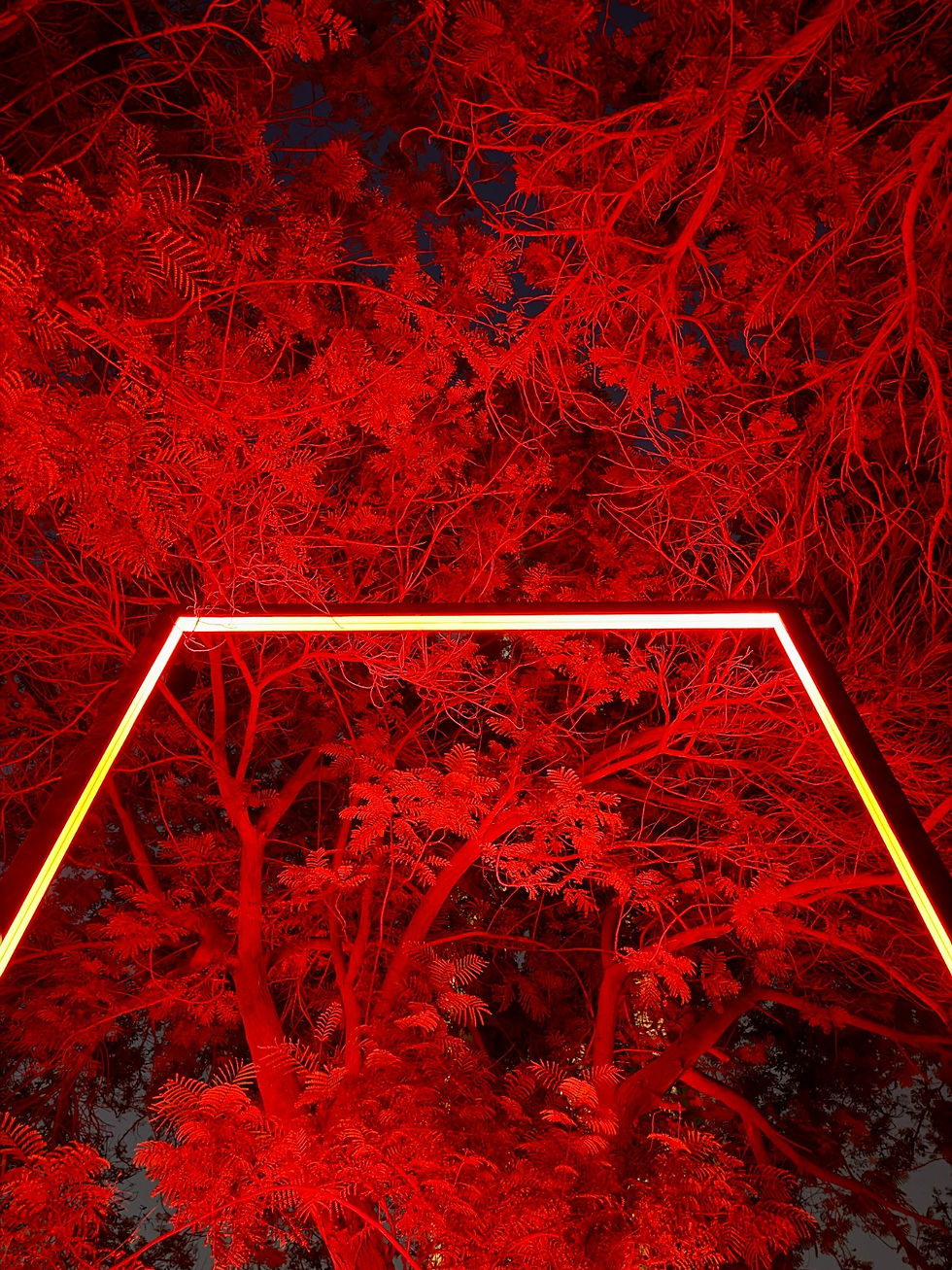
The installation consists of three large-scale vertical frames of light, each measuring 4 × 6.47 meters, positioned in front of three existing trees. The frames follow golden-ratio proportions, establishing a formal and conceptual relationship with the Dubai Frame while shifting the focus from the built environment to the living one. Where the Dubai Frame is singular, iconic, golden, and large, Framing Nature is plural, human-scaled, made of oxidised steel, and embedded within the landscape.
Rather than altering or redesigning the park, the project operates through reframing as a way to design attention. Trees, typically perceived as background landscape or urban infrastructure, are isolated, scaled, objectified, monumentalized, and presented as discrete objects of attention. Through this act, the installation monumentalizes the mundane through focus and presence.
Each frame features a continuous interior light rim, 10 cm wide, integrated into a clean structural profile. The light is oriented inward, illuminating both the framed tree and visitors as they pass through. The frames function as walkable thresholds, aligning body, structure, and nature within a single spatial composition. Directional uplights placed at the base of each tree create a complementary, diffused glow, enhancing the texture and depth of the trunk and canopy while contrasting with the clarity of the architectural frame.
The lighting uses a warm amber-red tone, selected for its ecological sensitivity and its ability to enhance the natural coloration of bark, foliage, and soil without overpowering them. The light follows a slow, breathing dimming pattern, inspired by respiration, introducing a subtle temporal rhythm that reinforces the sense of the installation as a living system rather than a static object.
Embedded capacitance sensors within the trees detect water and sap flow within the trees’ trunks. The invisible life of a tree, through data, is translated in real time into variations of light and sound, creating a responsive environment in which interaction generates atmosphere. The system does not seek to animate nature or simulate it, but to register presence, converting data into a restrained audiovisual language that remains secondary to the spatial experience.
The project works both at the individual scale and the collective, with three frames. The area is transformed into a conversation through light and sound between 3 trees, until visitors join the conversation by different means.
From a technical and design perspective, Framing Nature is conceived as a modular and scalable system. The frames are constructed as repeatable units, allowing the installation to be adapted to different sites, tree configurations, and contexts without altering its core logic. This modularity positions the work not as a singular artwork, but as a spatial strategy that can evolve across locations and scales.
Aesthetically, the installation balances precision and restraint. The frames are fabricated in treated oxidised steel, producing a muted, earthy material presence that complements the natural environment and avoids visual dominance. The contrast between the clean geometry of the frames and the organic irregularity of the trees is deliberate, reinforcing the project’s central tension between architecture and ecology.
Framing Nature does not propose nature as spectacle, nor does it romanticize it. Instead, it introduces a controlled architectural gesture that reorders attention. By applying the logic of monumentality to living elements of the landscape, the project invites visitors to slow down, observe, and reconsider what is worthy of focus in the contemporary city.

l1.jpg
092225 Digital Light Installation Walk19.jpg
a1.jpeg
l1.jpg
1/9
Project Team
Firas Safieddine
Cristian Rizzuti
bottom of page